
THE TEXAS RANGERS
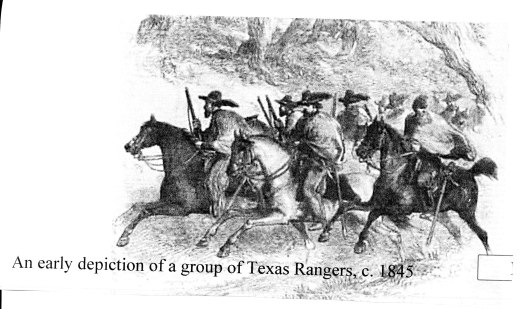
In the early 1800’s, Texas was thinly populated and could not afford a regular army. Noah Smithwick wrote: “so, the government provided for their protection as best it could with the means at its disposal, graciously permitting the citizen to protect themselves by organizing…ranging companies”. Fehrenbach in his book LONE STAR, wrote about the Texas Rangers formed in 1836. “They were one of the most colorful, efficient and deadly band of irregular partisans on the side of law and order the world has seen. They were all volunteers
Several of grandfather, Henry M. Anderson’s sons were Texas Rangers, both during and after the Civil War. Mitchell and John Henry Anderson, enlisted in the Texas Rangers in December 1860. Henry and Sarah’s daughter, Mary Anderson’s husband Phillip George joined at the same time. Family stories indicate sons William Walter and Albert James Anderson were Rangers, possibly after the Civil War
The Texas Rangers were a serious challenge to the Comanche rule of the Texas plains. The Rangers were described as “men that belonged to no army, wore no uniforms, made cold camps on the prairie and were intermittently paid”. They owed their existence to the Comanche threat; they fought and behaved like the Comanche. They were called by many different names including “spies, mounted volunteers and gunmen”. In 1838 they were officially named the Texas Rangers
Our kinfolk would furnish their own horses, equipment and food. Pay was set $30. a month, when it arrived at all. Each Ranger had a rifle, two pistols, a knife, a blanket secured behind their saddle and a small container of salt, flour and tobacco. They moved lightly over the prairie, just as the Indians did, without a tent and using a saddle for a pillow. The Anderson and George boys had to be mighty tough to survive the life of a Texas Ranger
The Anderson and George families passed along stories about Rangers Mitchell, John Henry Anderson and Phillip George. They were involved in the famous raid of a Comanche camp and finding Cynthia Ann Parker, mother of Quanah Parker.
Cousin James A. George wrote this story of Cynthia Ann Parker “In 1836 a large party of Comanche and Kiowa warriors attacked Parkers Fort near Groesbeck. The raiders carried off nine year old Cynthia Ann Parker and adopted her into the tribe. She was seen by traders over the years and attempts were made to ransom her but her Indian family would not bargain. The Comanche birth rate was extremely low and young female captives were believed as essential part of the tribe.
Cynthia Ann quickly adjusted to Indian life and grew to become wife of Peta Nonona, a noted war chief. She bore him three children including Quanah, who would later become the noted war chief of the Kwahadi band of Comanche”.
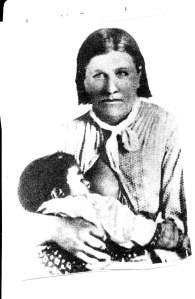
Cynthia Ann Parker with her child Prairie Flower.
Our cousin Archie Anderson, granddaughter of Ranger John Henry Anderson, wrote; “On December 1860, while the Anderson family lived at Fort Belknap, a Comanche expedition was mounted of forty Rangers, twenty Army soldiers and some seventy local volunteers
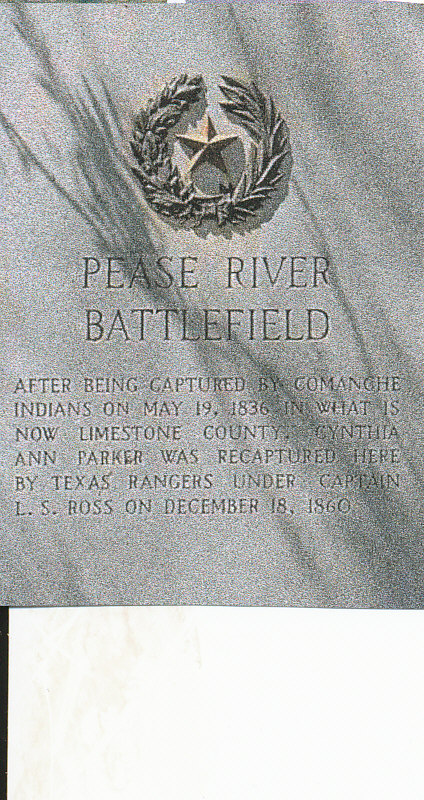
James A. George wrote; During their period of enlistment in the Rangers, Philip George, Mitchell and John Henry Anderson participated in the raid on the Comanche camp, on the Pease River, south of Vernon, Texas. During the attack the Rangers and U.S. Army regulars captured several squaws”.
Archie Anderson wrote; “It was her grandfather who found Cynthia Ann Parker (Quanah Parkers mother) with her baby Prairie Flower in her arms and he noted the freckles on her arms and knew she was white “. Archie said that she knew her grandfather, John Henry Anderson and he shared these Ranger stories to his grandchildren.
James A. George wrote “After the Rangers noticed that one of the Indian women had fair skin and blue eyes. There was a great deal of discussion about her identity and it was eventually suggested that she might be Cynthia Ann Parker. Though she could barely speak English , Cynthia Ann identified herself as the little girl who had been captured years before. Cynthia Ann Parker was re-united with her Anglo relatives, but she did not adjust well to the life of a white woman. She grieved herself to death after a short while”
Quanah Parker had left the village prior to the attack, Quanah became the last and greatest chief of the Comanche’s. In the book EMPIRE OF THE SUMMER MOON there is a different version of who found Cynthia Ann, the book gives credit for finding her to the Rangers Captain Sul Ross. The book describes Ross as a “ wiry, ambitious young man!

Quanah Parker
We are not sure which version of finding Cynthia is correct. But we like James A. George and Archie Anderson’s story. Archie’s story was told to her by her grandfather John Henry Anderson (who was there). We believe that John Henry and Mitchell Anderson and Philip George found Cynthia and turned her over to the ambitious Captain Ross ….who took the credit.
 ARTIST DRAWING OF THE GREAT BRIDGE
 Who is my granddaddy?