Dear Kinfolk,
A shooting at the local saloon of La Junta, Colorado, in the year of 1886, was an event that would change our grandfathers life for the next 9 years.
William Henry Anderson’s nickname was Black Bill because of his coal-black hair. One evening Black Bill and his uncle went to the local saloon in La Junta.
While there, an argument started, guns were drawn and a man was killed. The blame went to either Black Bill or his uncle, we will never know for sure. However, many years later, he told one of his daughters “I took the blame because my uncle had a family and it would have been hard on his family if he was jailed.”
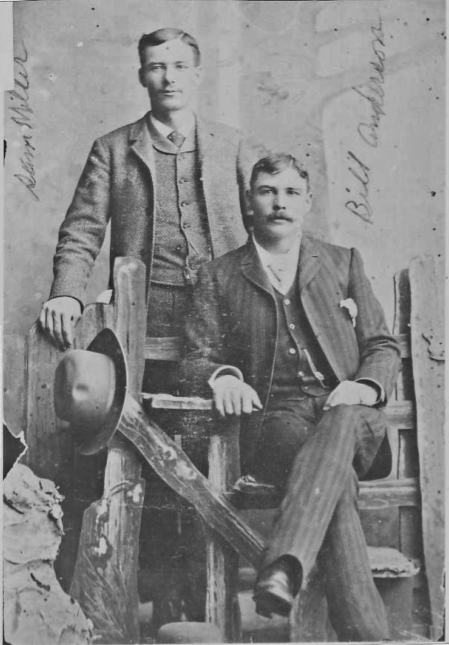
Black Bill Anderson and his friend Sam Miller.
Shortly after the shooting, and before the sheriff arrived, they went to Black Bills folks, our great grandparents, Albert J. and Nancy Anderson. They decided that their son should leave immediately. Albert saddled up his best horse and Black Bill left La Junta in the middle of the night.
That put the blame on Black Bill and his uncle was a free man. The story was verified years later by a gentleman who ran the La Junta Historical Museum. He said that he had heard that story from and elderly man in the local nursing home who said “he made his escape on a real fine horse and did not come back to La Junta for nine years.”
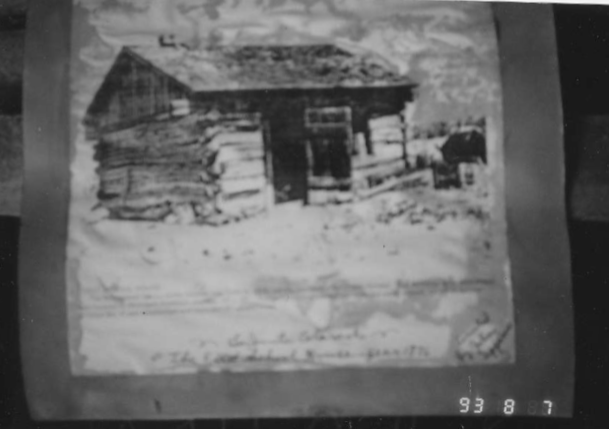
Original log cabin built by Albert J. and William Anderson.
William Henry Anderson was the first child of Albert J. and Nancy A. (Wilson) Anderson. He was born in Fort Davis, Shackleford County, Texas on August 28, 1867. The word “Fort” is a misnomer since it was not a military post. It was a key trading and supply center where Indians and trappers could bring their fur pelts, traders could stock their beads, blankets, knives, mirrors, and foofaraw (trinkets). Western emigrants could buy supplies and wagon parts. Most important, since Indian raids were common, it was a safer place for the white man and his family to live.
According to our aunts, during Bill’s first five years at Fort Davis, his father “circulated around the Indian country.” It is believed that Albert had served in the U.S. Civil War for the Confederates.
Records show an A.J. Anderson in the 2 Cherokee Mounted Volunteers as a private in Company K. Possibly he was a Texas Ranger after the war and did truly “circulate around the Indian country.”
After Bills first five years at the Fort, “Albert put everything on a train in Kansas and shipped them to La Junta, Colorado.” This was the spot where the famous Santa Fé Trail turned south.
La Junta was comprised of one log cabin school-house, built by Albert and his son Black Bill. There were approximately 285 residents, one hotel. three saloons, two section houses, eleven residences, one general store , two restaurants, one engine pump house, one Adams Express House, one ice house, one Wells Fargo station, one blacksmith shop, one boarding tent and one barber shop.
We do not know the level of Bill’s education, only that he was still in the one room school at the age of 12. Also, quite remarkably, he could speak Spanish, Cherokee and English fluently.

Jim at the La Junta Historical Museum replica of the first school house.
OK….. cousins Billy Don, Lela Faye, Jackie, Billye and Lynn, what do you remember about our Granddads life? I have taken most of my story from stories told me by our Aunts Georgia Faye, Leona, Noma. and that was 30-40 years ago! Any help or corrections will be most appreciated. My next blog will be about our grandfathers life “on the run.”
Hope you enjoy the story.
Jim Lee
 Who is my granddaddy?