Dear Kinfolk,
 In 1860 the Anderson family was living in Fort Belknap, Texas. Belknap was established in 1851 by General Wm.G. Belknap to protect the Texas frontier against raids by the Kiowa and Comanche Indians. Prior to the outbreak of the American Civil War the post was abandoned, partly as a pullback of Federal troops to the north, and partly due to the fort’s unreliable water supply.

Fort Belknap

Fort Belknap
In February 1861, the Texans voted 171-6 in favor of secession from the United States. Three months later the Confederate batteries opened fire on Fort Sumter in the Charleston Harbor, signaling the start of the Civil War. Like thousands of men in the Confederate states, the Anderson boys responded in anticipation of a “brief and glorious war”. Only Phillip Jefferson Anderson, age 9, would have been left home with his mother and sisters to fend for themselves——in Comanche country. The mens ages at the beginning of the Civil War were, Henry M. 52, Albert 24, Mitchell 23, John Henry 22, and William Walter 16.
We know that Mitchell (1) and William Walter were Texas Rangers. There is a strong possibility that some of the boys served both as Rangers and Confederate Soldiers. A Henry M. Anderson was listed in Company E., 6th Infantry, Texas. I have found records of A.J. Anderson in the 3rd Texas Cavalry, Confederate States Army. The 3rd Cavalry was organized in Dallas, June 13, 1861. Another record shows Albert J. Anderson in Capt. J. Raven Mathewes Co. Heavy Arty, South Carolina Vols. Further research required to decide the Anderson families exact participation as either Texas Rangers, Confederate Soldiers or both.
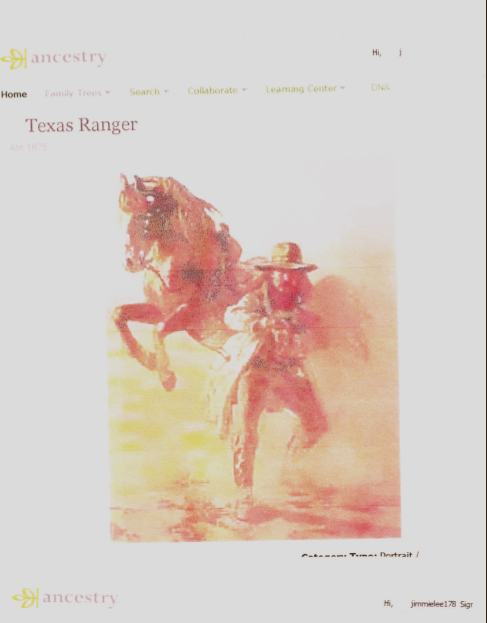
Texas Ranger history is fascinating. The first serious challenge to the Comanche rule for the Texas plains were men that belonged to no army, wore no uniforms, made cold camps on the prairie and were intermittently paid. They owed their existence to the Comanche threat: they fought and behaved like the Comanches. They were called by many different names including “spies, mounted volunteers, and gunmen”. It was not until around 1835-40 that they finally had a name everybody could agree on RANGERS.
Texas Ranger
They furnished their own horses, equipment and food. Pay was set at $30 a month “when it arrived at all”. Each Ranger had a rifle, two pistols and a knife. A blanket secured behind his saddle and a small container of salt, flour and tobacco. They moved lightly over the prairie, just as the Indians did, without a tent and a saddle for a pillow at night. (2) The Anderson boys had to be mighty strong to survive the life of a Ranger!

Texas Ranger
According to our distant cousin, Archie Anderson Brewer (3), “John Henry Anderson was a soldier in the Civil War 1860-64. He fought in the Confederate Army along all his brothers. He was in the Texas Campaign and Western Campaign and later scouted for the United Sates Army in Oklahoma Territory”.
Archie wrote an interesting story about Cynthia Ann Parker, her son Quanah, and our great Uncle John Henry Anderson. On December 1860, while the Anderson family lived at Fort Belknap, a Comanche expedition was mounted consisting of forty Rangers, twenty army soldiers and some seventy local volunteers. According to Archie, John Henry Anderson was part of this expedition (possibly other members of the Anderson family were involved). During a raid on a Comanche village, John Henry Anderson found Cynthia Ann Parker with her baby (Prairie Flower) in her arms and he noted the freckles on her arms and knew she was a white woman.

He turned her over to the Commanding Officer. In the book EMPIRE OF THE SUMMER MOON, there is a different story. The book gives credit to Commander Sul Ross for discovering Cynthia and her baby. The book goes on to say Ross was a “wiry, ambitious young man”. Cynthia’s son, Quanah Parker, had left the village prior to the attack. Quanah became the last and greatest chief of the Comanches. I am not sure which story is correct, but I like Archie’s, John Henry’s discovery best.

Next chapter we will visit life after the Civil War at Fort Davis, Texas.
Jim Lee
Reference;
(1) Cousin Barbara Close great grandfather’s was Mitchell Anderson. She advised that he was a Texas Ranger.
(2) Ranger history taken from the book EMPIRE OF THE SUMMER MOON by S.C. Gwynne.
(3) Archie Anderson Brewer was a cousin in our lineage. She did extenive research in the 1950-60’s. She passed away in the 1980’s.
 Who is my granddaddy?