
“OL’ GIRLS…THAT’S MY MAN

Chapter 17

OL’ GIRLS…..THAT’S MY MAN”!

By the age of 21, William H. Anderson, aka “Black Bill or Bill Lee” had escaped from the law in La Junta, Colorado and a jail in Old Mexico. Both times late at night. He was probably not guilty of the La Junta saloon/theater shooting and definitely innocent of breaking any Mexican laws.
The Bisbee Police Force picture came from granddad's locker. Not sure why he had this picture, maybe to show he was on good terms with the sheriff.

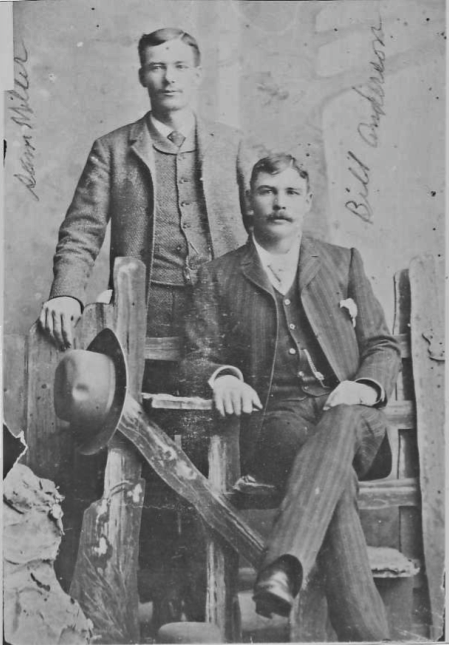
                                                                                                                  Bill Anderson and friend Sam Miller 

After the Mexican jail escape, Bill returned to the Slaughter Ranch. The ranch was beginning to prosper with the cattle herds now safe from any danger of Geronimo Apache raids. Bill Lee and the other cowboys had made Slaughters spread immune from Geronimo. After Geronimo was captured, he was made prisoner at Fort Sill, Oklahoma Territory. While there he was visited by Mrs. Nancy Tubert, the niece of John Slaughter. The exiled chief looked at her glumly and said that there were only two things he would like to do before he went to his heavenly hunting grounds (1) kill John Slaughter and (2) die in Arizona.

 Geronomie

Sometime in the early 1890’s, Bill left Arizona and started working Texas ranches on his way back to La Junta, Colorado (his folks must have written him it was safe to come back home). On one of the cattle drives, he attended a square dance in Quanah, Texas. As he and his cowboy buddies walked into the dance hall, pretty Tommie Lee Boles, spotted him and immediately told her girlfriends “OL’GIRLS THAT’S MY MAN”. They danced most all of the evening. The following day Bill rode out to meet Tommie’s folks before departing for Colorado. Their daughter Noma wrote “they did not see each other for three years, but they corresponded regularly during their separation. By mail, they decided to meet and be married on April fools day, April 1, 1894 in Quanah, Texas

Marriage certificate

                                                                                                                 Marriage Certificate on April 1, 1894 

Black Bill’s bride, Tommie Lee Boles, was born in Van Zandt, Henderson County, Texas, on October 28, 1871. Her childhood home was the same location chosen by Chief John Bowles, for his Cherokee tribe, in the early 1800’s. The Chief and his followers had refused to participate in President Jackson’s infamous forced “trail of tears” march from the East Cherokee Nation( Carolinas and Georgia) to the Oklahoma Territory. Tommie’s father Levi Boles and grandfather William Boles,  followed the tribe from their home in Abbeville, South Carolina (East Cherokee Nation) to the village in Henderson County, Texas. It was probably the best-known Cherokee village ever established in Texas.

Chief Bowles was quite involved in early Texas history.   Texas was worried about a war with Mexico and they needed the Indians on their side. The Cherokees were not large in number, but they were experts with their rifles. General Sam Houston had a close and warm relationship with Chief Bowles. Houston negotiated a peace treaty with Bowles, after the signing he presented Chief Bowles with a sword, a silk vest and a sash.
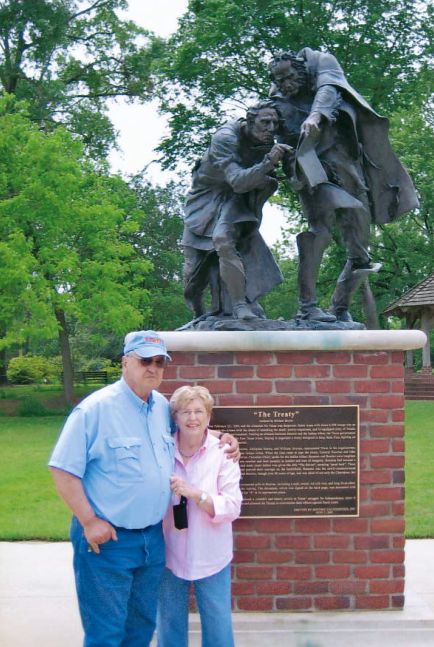
Aunt Joy and Uncle Eddie in front of Chief Bowles and Sam Houston's statue.

Aunt Joy and Uncle Eddie Roberts in front of Chief Bowles and Sam Houston’s statue. The signing of the Texas Peace Treaty. Located in Nacogdoches, Texas.


Sadly, later Texas decided to break the treaty and send Chief Bowles and his villagers to Oklahoma, Territory.  They refused and Bowles was killed by Captain Smith.  “His horse shot out from under him, the Chief rose to his feet and as he started to walk away he was shot in the back. Bowles took a few steps and fell, then rose to a sitting position facing his captors, Captain Smith approached him and shoot the Chief in the head. He died on the field of battle and his people lost their Texas Paradise. He was wearing the sword and vest given to him by his “friend” Houston. Mary Whatley Clark has written about these incidents in her book titled CHIEF BOWLES AND THE TEXAS CHEROKEES.
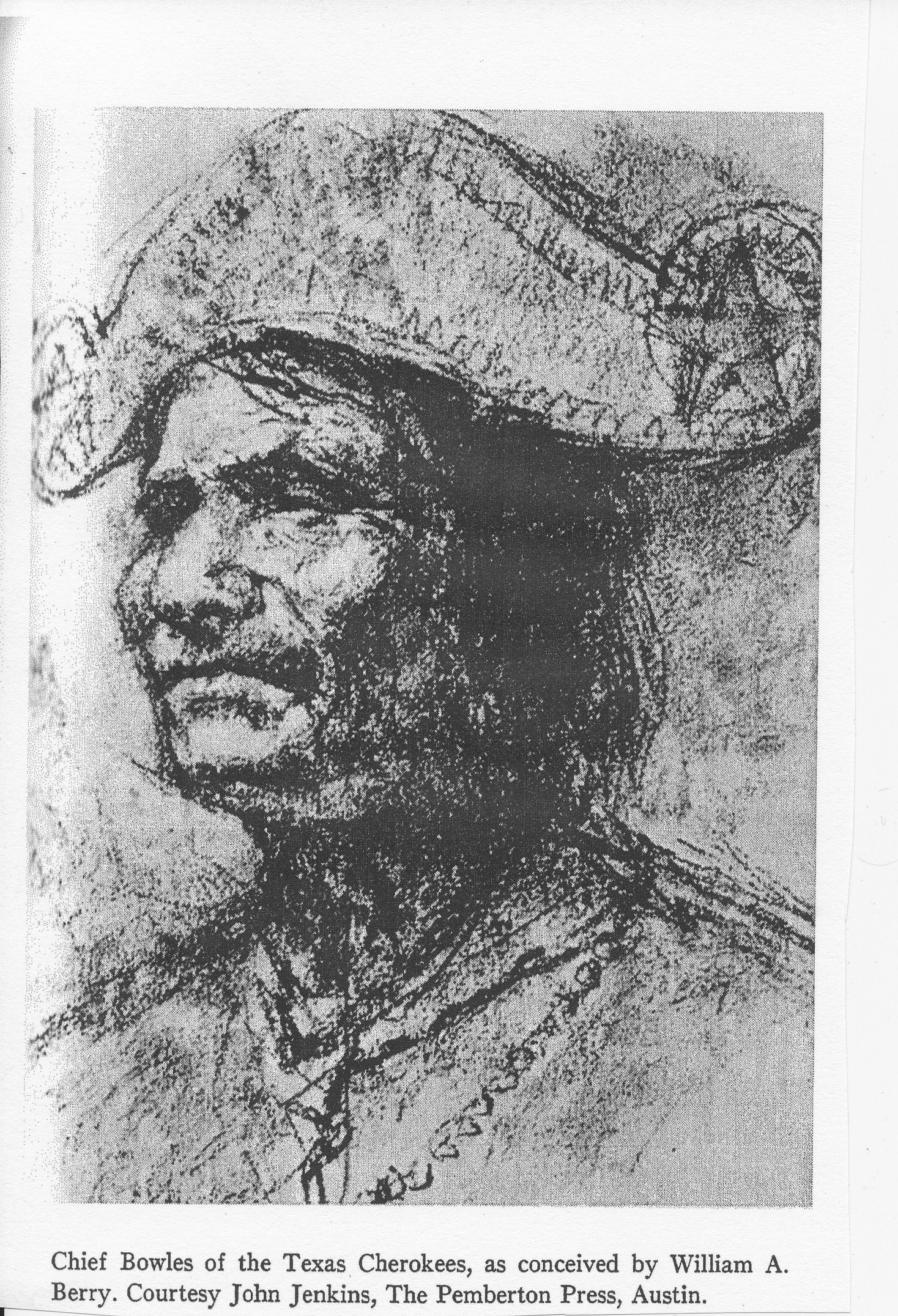
 Chief John Bowles

Our family’s relationship to Chief Bowles was revealed when Tommie and her father Levi made application for Cherokee Citizenship with the Dawes Commission in 1896, case #4618. There were affidavits submitted with their application confirming their Cherokee blood.   One read “In the case by Levi C. Boles, age 64, he is a cousin to Johnson Boles, Lightening Bug Boles, Joe Boles and a distant relative of old Chief Boles”. Other confirming affidavits were given by Saike Splitnose and George Dreadful Water. It is my belief that our gg great grandfather, James Boles, born 1760, and Chief Bowles, born 1765, were brothers. They both said their father was a Scotch Irish trader and their mother a Cherokee. They traveled the same path after leaving South Carolina. Tommie Lee Boles always claimed she was Scotch, Irish, Indian.

Tommie and Levi’s Cherokee application to Dawes was rejected. To be approved by Dawes Commission, the party’s names had to appear on the East Cherokee Nation rolls.   Our Indian relations and many eastern Cherokees hid in the mountains, rather than signing the white mans rolls. Signing would be used by the government to identify the Indians and later force them to move from their eastern Cherokee hunting grounds, to Oklahoma Territory. We believe the choice of Chief John Boles and his tribe, was not to sign. Research has found several early name spellings… Boles, Bowles, Boll, and Bowl.

According to our Aunt Noma’s letters about her mother Tommie, “their home in the Henderson County, was a “dugout”. When Tommie as 4 years old, her mother, Nancy Gore Boles, died giving birth to her son Jetti L. Boles. Tommie’s sister, Ellen, age 12, took over the raising and cooking for her siblings…. John W., James R., Tommie Lee, and Jetti. (Nancy Gore was related to the blind Oklahoma Senator Gore).

We do not have much information about Tommie’s early life. She was only able to go to school until the forth grade, which was typical for those times. When she could no longer attend school, she got a dictionary to teach herself how to spell and write (she had a beautiful handwriting). She and her family moved from Chandler, Henderson County, to Quanah and eventually Bowie, Texas. Like Black Bill’s family, all the Boles moves were made to northwest Texas, by covered wagon.   Fortunately the trails led to a square dance in Quanah, Texas

                                                                         CHEROKEE LOGIC

After listening to biblical passages read in Cherokee, Chief Drowning Bear said, “It seems a good book but it is strange that the white man who has heard it so long is no better”.
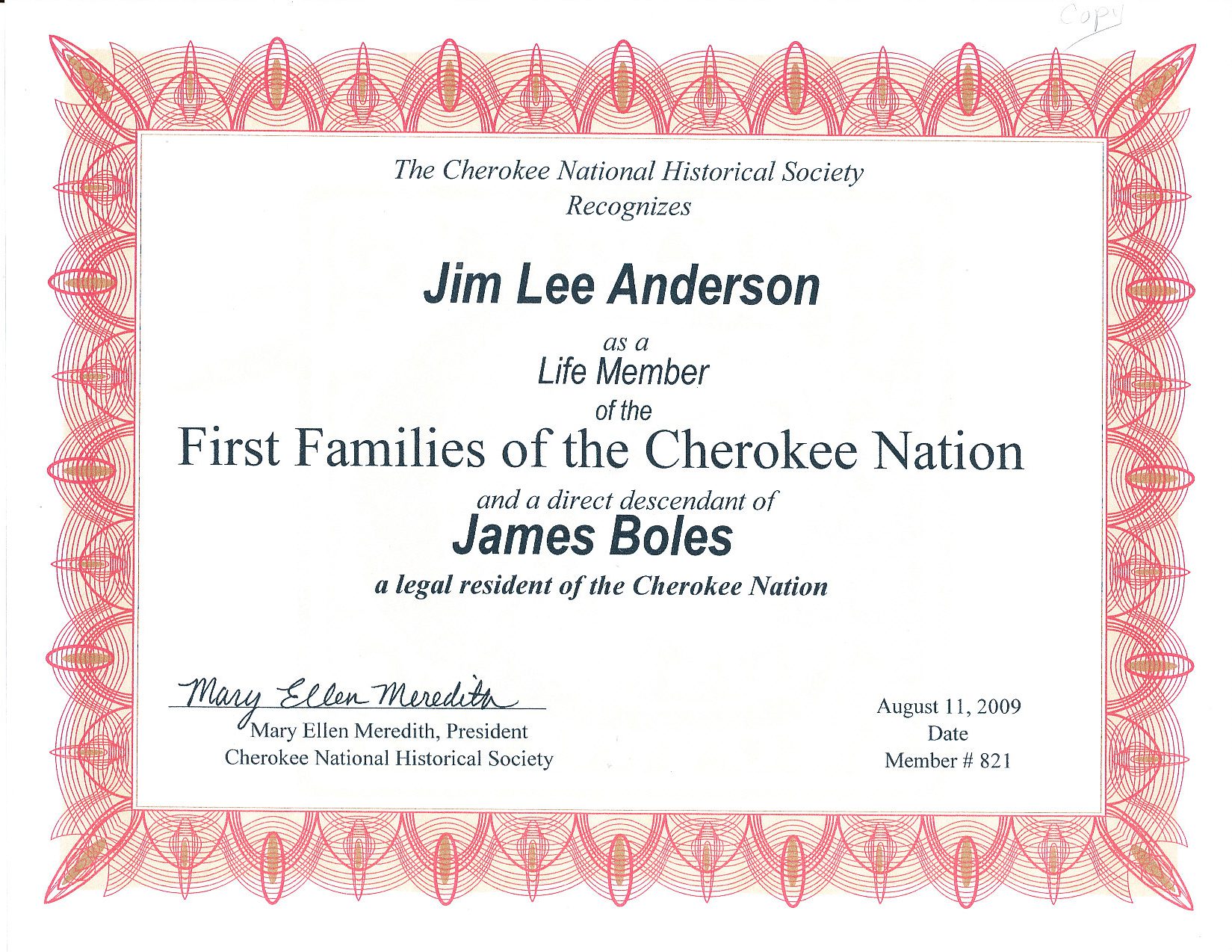
First Family of Cherokee Nation


Posted in Anderson | Leave a comment

CHEYENNE – ARAPAHO LAND RUN


Chapter 12

CHEYENNE-ARAPAHO OPENING

The Cheyenne-Arapaho Land Run began when the cavalry men fired their guns into the air at noon on April 19, 1892. People who were twenty-one years of age or older could place their stake in a 160 acre tract of land; live upon it for five years; make improvements and the deed was theirs. They rode in covered wagons, rode horseback and ran on foot to acquire this land in the third of five land runs into Oklahoma Territory.

Our kinfolks who lived in and around Canadian Texas, only had to journey 20- 25 miles to the Texas-Oklahoma border in order to participate in this land run. Judy Tracy tdale55@aol.com of Cheyenne, Oklahoma, compiled a list of “runners” who entered from the west side (Texas line) on that adventurous day. It was quite a surprise to find the name Henry M. Anderson (age 82) on the list of participants!  There are no family stories about his claim, or if he stayed on his  claim. We do know that Henry passed away four years later at his ranch in Hemphill County, Texas. Many settlers left after two Cheyenne Chiefs told them to leave within “three sleeps”. We do know that this threat would not have bothered Henry or his sons 

Other ANDERSON names on the list of runners were Archie, Fayette, J.A., John H. and Martha Emma, W. W. ( William Walter) and Susan, Ab (Albert?),and Ben. Not shown on the list was Henry’s grandson William Henry Anderson, who made his claim near Red Moon, Oklahoma Territory.

Other names of interest were Herman and Charles E. Guernsey. Charlie was the uncle of my mother, Alida Guernsey Anderson. Uncle Charlie and his wife Mary came from Adobe Walls area of the Texas Panhandle to make the run. He had already led a varied an interesting life. As a government scout, he had been appointed by President Grant in 1869 to lead a colony of Quakers from Smyrna, Iowa to Indian Territory near present Chandler, Oklahoma. It was hoped that the peaceful ways of the Quakers would have a civilizing effect on the Sac and Fox Indian

When Charlie arrived to make his run to “F” county (later named Roger Mills County), he received a last minute notice that he was given a commission as Territorial Sheriff, until an election could be held. His appointment was made by the man for whom Roger Mills County was later named, Roger Q. Mills, a Texas Congressman.   This was quite a disappointment to Charlie, as he came there to make the run. Unfortunately, it was too late to decline the appointment . In 1903 Charlie moved again to purchase the land where the Oklahoma City Stockyards plus Wilson and Armour Company meat plants, were later built.

A map of the Cheyenne and Arapaho Reservation shows how close the land run was to  our kinfolks Texas ranches.

Land run map_0001

The 3.5 million acres of the Cheyenne-Arapaho Reservation was opened by a proclamation from President Benjamin Harrison on April 12, 1892. The land run followed on April 19, 1892. This was 23 years after the Cheyenne – Arapaho Indians, living in Colorado, were moved to Oklahoma Territory and promised by the U.S. Government that it would be their land. Another broken promise.

The “sooners” ( those settlers who tried to stake their claim before the official date) shunned this land opportunity, giving the “boomers” time to deliberate and to evaluate various claims. Relinquishments later sold for a horse, a buggy or as little as five dollars. Some settlers declined to participate as they thought the region so barren that “about the only sure crop was the rattlesnake”. Cheyenne – Arapaho Opening, Encyclopedia of Oklahoma History and Culture. Oklahoma Historical Society.

Henry and Sarah’s grandson, William H. (Black Bill) Anderson, along with his parents, Albert and Nancy Anderson, made claim on Rush Creek, about 18 miles north and west of Cheyenne, Oklahoma Territory. This was in the Red Moon Agency area(named for Chief Red Moon).  After the land run a reservation school was built to teach the Cheyenne and Arapaho children how to farm. Albert and Nancy did not stay long, but Bill and his wife Tommie Lee stayed on the claim for 22 years, during which time he obtained his Homestead Deed. They then moved to Strong City, Oklahoma, where he became a Roger Mills Deputy Sheriff.

Land run map_0005

                                                                                                       Red Moon Homestead 1904

Top left…Orren, father William Henry Anderson, Noma, mother Tommie Lee.

Bottom left…Lillie, Virgil and baby Jack Anderson.

Life in Red Moon area was not easy. “Not even food and water were certain. Much of the water was hard and gypy. Families often scoured the prairie for bleached buffalo bones to sell for food”. William had a garden and livestock, but his daughters said he preferred to make a living playing cards (Faro). Another “tough times” story of life in the early Oklahoma Territory.


Posted in Uncategorized | Leave a comment