Chapter 8.
“FORT UP” AT FORT DAVIS 1864-1871
In 1864, the Kiowas and Comanches raided Fort Murrah and the Elm Creek settlement… It resulted in the death of nine individuals and the capture of a number of others. This raid would be in an area west of where the Anderson ranch was, near Fort Belknap. The fury of this raid made the Anderson, George and Ratliff settlers reconsider their isolation. They chose to gather their families onto closer groups for mutual protection. The area chosen was the family fort, Fort Davis. The success of family forts like Fort Davis allowed settlers to remain close to the ranches they had occupied prior to the Elm Creek raid. Fort Davis: A Family Frontier Fort by Clifton Caldwell.
Fort Davis was constructed in Stephens County, Texas, during the final years of the Civil War .The fort was named for Confederate President Jefferson Davis, This family fort is not to be confused with the other U.S. Military Fort Davis, which is located several hundred miles to the southwest of Stephens Count
The significance of Fort Davis lies in the fact that it was a major force in providing protection for ranchers who remained in the rolling plains southwest of Fort Worth during the later part of the Civil War. In the absence of adequate military protection, families realized that they would have to “fort up” together or would have to retreat east to larger settlements like Ft Worth. We do not believe “retreat” was in our family’s vocabulary.
Fort Davis began in October, 1864, “on a flat terrace that was then occupied by Mich Anderson”, Henry and Sarah’s son. Susan Newcomb n.d. Mitchell had built a stone house on the property and it is generally believed that this is the same as the one that is still standing at the site. Originally the house had two rooms, one kitchen and the other living area. The house is the only structure left on the fort site today according to cousin Barbara Close. By January 1865 the fort had “over twenty good houses finished. From Diary of Samule Newcombe n.d..
In spite of the Civil War and dread of Indian raids, the settlers did have their share of merriment and festivities. There were feasting, dancing and weddings, including two in the Anderson family. Albert J. Anderson married Nancy Alveria Wilson on October 1, 1865 and William Walter Anderson married Susanna Virginia Frans on December 25, 1865.
It was no trouble at all to get up an old fashioned square dance, fiddlers were rather plentiful and accommodating. They would play all night for a small sum. The young men would pass the hat and take a collection while dancing went merrily on. The women had quilting parties and were joined by the men when eating time came. There were candy pulls, the candy being made of molasses in a wash pot out in the yard. There would always be candy making at weddings, which perhaps was for the entertainment of the children principally. When nothing else offered itself, there was the age old diversion of jumping rope.
On one occasion there was a dance and some of the young men had ridden from neighboring ranches and tied their horses near the house. After the dance they went out to get their horses and they were gone! It was discovered there had been another dance under the river bank nearby. The soft earth had been patted down by moccasin feet. The Indians too had enjoyed the music of the fiddlers and had danced before taking the young men’s horses. Story from the book INTERWOVEN.
Samuel P. Newcomb was the teacher at the Fort Davis school during its beginning days. Fortunately for historians, Sam Newcomb and his wife kept diaries which give us a wonderful look at the way our ancestors lived during the 1860’s, the worst years on the Texas frontier. Our family relation the George, Wilson, Ratliff and Anderson are mentioned throughout the diaries.
The following are just a few references to our families. Five pages of his diary are available upon your request.
January 1, 1865….. The Indians have been so troublesome that many settlers have left the frontier and gone to more settled areas. Fort Davis is on the northeast bank of the Clear Fork Brazos. There are about 120 persons in the fort and others are preparing to move in.
January 20, 1865….. The people of the frontier are in the service of the State of Texas, so not in Confederate Army, they are exempted to care for women and children who shouldn’t be left alone, they have to scout (Ranger) one forth of the time. Tells of 450 white men going after an Indian camp, the Indians raised white flags but the men went in after them anyway. The Indians won.
February 12, 1865….. Expect to raise the schoolhouse tomorrow.
February 13, 1865….. This morning the scout was disbanded. M.H. (Mitchell) Anderson and T.B. Bromfield and others started back home.
March 1, 1865…… Raised a large house for old man Anderson. (“Old man” Henry M. Anderson would have been a ripe old age of 56).
March 7, 1865 ….. Last night M.H. Anderson brought in three stray horses that he had found, supposed to have been dropped by the Indians. One had a bridle and lariat.
April 25, 1865…… A bad storm with wind blew down Mr. (Henry M.) Anderson’s house, which made a great noise with its dirt covering roof and large timbers.
April 25, 1865….. The soldiers in the C.S.A. (Confederate States Army) returned after being disbanded, as all the southern army has. The wife (Prudence Anderson) and daughter of Phillip George and old Henry George came up with them.
July 22, 1865….. John Henry Anderson, Robert Graham and Stephen Frans left here yesterday morning on a small Indian trail not expecting to be gone out a few hours.
May 30, 1865 ….. They hear the war is over. ‘
September 20, 1865….. Albert Anderson got in from Weatherford this evening and had not been two long until it was reported around town that he was going to get married in a week or two. (Albert J. Anderson married Nancy Alveria Wilson on October 1, 1865. Nancy was a sister of Martha Emma Wilson who married Albert’s brother John Henry Anderson).
September 27, 1866 …… This frontier of Texas, where the wild Indians are continually depredating on the people killing, stealing and driving off our cattle. They have killed and scalped many a one of our poor countryman. And they have captured many little children.
April 1, 1867 …..Many men including John and Mitchell Anderson went on an Indian hunt. They fought them near the double mountains on the Brazos and got three Indian scalps. John Anderson was wounded, shot through the arm with an arrow.
September 7, 1867 …..The men all went buffalo hunting and came in tired and hungry. They had killed fourteen buffalo and three deer.
June 22, 1867 ……. This surely is the last place on earth for a woman to live, or anyone else. I don’t believe it was ever intended for civilized people, it was made for the wild Indians and buffalo. (Tough times for our pioneer families).
The diary of Samuel and Suzan Newcomb ends when they leave Fort Davis, sometime after 1871, Although there appears to be a sequel which can be found at the University of Texas Tech at Lubbock in the Southwestern Collection. Other information for this story in the lives of our kinfolks was taken from Fort Davis: A Family Frontier fort, by Clifton Caldwell.
In 1867 Henry and Sarah Anderson became grandparents. Albert and wife Nancy had their first son, William Henry Anderson. There were no doctors at Fort Davis, so they traveled to Weatherford, Texas, where William was born.
With the end of the Civil War in the spring of 1865, was the collapse of the Confederacy, which brought final and complete chaos to the frontier. Before there had been at least a pretense of organization. What had happened was the state and territorial militias, the core of the frontier defense for four years, had simply melted away. In the Confederacy they were forcibly disbanded as punishment from Washington D.C. (some things never change).
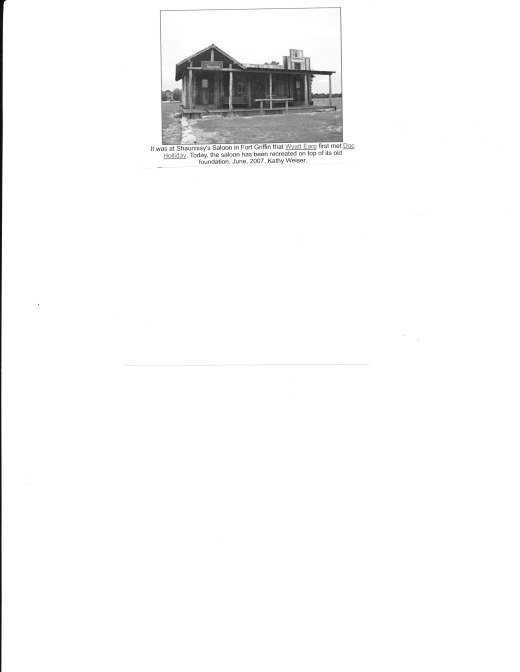
Henry M. Anderson and some of his children remained at Fort Davis unto the early 1870’s. It is likely that he continued his occupation of trading horses and cattle to the Military. Their next move would be to Fort Griffin, which was established less than ten miles from the Anderson’s ranch. It was a bustling center of activity where Buffalo hunters and gamblers swarmed over the area. Indian conflicts were frequent and bloody.
 Who is my granddaddy?