
HANGING BROTHER JAMES
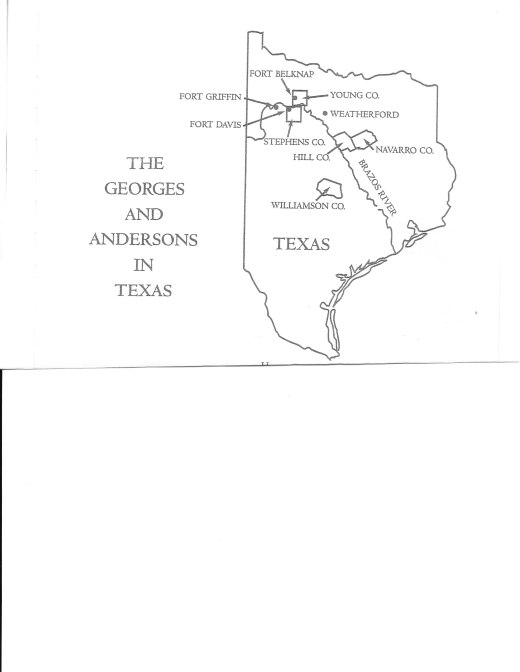
James “Jim” Washington Anderson, born 1829, was the oldest of Henry and Sarah Anderson’s eleven children. Before James moved to Young County, Texas, he had married Margaret Eaves and had two children, James W., and Sarah, both under 5 years old. He was listed as a “rancher”, the creek that ran into the Brazos River from his ranch is called the Jim Anderson Creek. The following is the story on James tragic death.
The first Young County District Records concerning James appeared in 1860, THE UNITED STATES vs. JAMES ANDERSON –GAMING. It was against the law in Texas to gamble, James Anderson was indicted on playing cards in a gambling house. Although gambling in Texas had long been against the law, there was not a pioneer or man in Texas that had not gambled. Every Saloon had gambling tables, somewhere in the house. Prostitution was against the law also, but we have read about the “Chicken Ranch” which existed in Texas for many years. The movie, Best Little Whorehouse in Texas, was based upon the Chicken Ranch of South Texas
Much information for the following story was obtained with the help of Mr. Dorman Holub, a professional researcher, Ms. S. Krehbiel and Barbara Close, a great granddaughter of Mitchell Anderson. Many years later, cousin JoRetta Lewis, a great granddaughter of Lucinda Anderson Ratliff, was curious about the death of James and began inquires. …… she found that James Anderson was killed in Young County, Texas in the month of April 1860. The court records were found in the Texas State Archives, Young County District Court Records, and Volume 1. When the gambling case came to court they were told of his death and the case abated.
By 1860 it was estimated there were four to five million head of cattle of cattle in Texas. The Anderson boys would round up the wild un-branded longhorn cattle and place their brand on them, all very legal. Each boy would have his own brand, great grandfather Albert J.’s brand was a simple A J.
YOUNG COUNTY DISTRIC COURT RECORDS, Vol.1, page 53, no. 32, (1860) The United States vs. James Anderson. Marking and branding cattle.
James Anderson had been stealing cattle from two men, then changing just a little slant on the cattle brand, to make the brand like his. The two men’s brand was so close to James Anderson’s, making the change simple. The Young County Sheriff caught James stealing cattle from the two men and he was taken in. (The cattle that James Anderson was stealing and changing brands belonged to his brothers, John Henry and Mitchell Anderson).
Local rumor indicates that John and Mitchell Anderson hung their brother. Perhaps they didn’t want the community to hang him? Perhaps they did not want their brother to face another trial? When the first jury could not decide, maybe they felt they should carry out justice themselves
YOUNG COUNTY DISTRICT RECORDS, page 56, May 24, 1860. The State of Texas vs. John Anderson and Mitchell Anderson. Assault with intent to kill.
After hearing the evidence on John Henry and Mitchell Anderson, the argument of counsel and after our deliberation had thereon returned to the court “WE THE JURY CANNOT AGREE. M.A, Thompson, FOREMAN”. Judge R.L. Waddell, District Judge advised that a mistrial be entered on record and the case stand continued until the next term of court. District Court would meet two more times before final dismissal. On August 8, 1861, the jury was suspended and the District Court in Young County ended due to the Indian uprising in the county. Hence, the court case never came back for continuance!
One of our cousins wrote, “it would have been hard to get 12 Jurors to convict the Anderson brothers for killing a cattle thief, when the un-written law in Texas was…hang a cattle thief. When you stop to think, this great country was carved out and created by folks like the Andersons, Ratliffs and Georges and many, many others. Illiterates, tough men with determination, strong women with more courage than most of us have seen in a lifetime. Their history is fantastic and interesting; I am honored to share a small leaf of their family tree”.
We will never know how Henry and Sarah Anderson took the loss of James. It is hard to imagine the scene when Mitchell and John Henry returned to their folk’s house to tell their parents what had happened to their son James. Several years later John Henry Anderson wrote his sister Lucinda and said “I will say this much that I will never come to Texas any more to live”. The reason could not have been the dangerous life in Comanche country, the boys were simply not afraid. Our cousin wrote “I now feel that his memories of Texas and Young County and his brother, so burdened his heart that he would never return to live there”.
TOUGH TIMES NEVER LAST, BUT TOUGH PEOPLE DO.
 Who is my granddaddy?