
Chapter 3 WHY TEXAS?

We can only imagine what went through Sarah’s mind when Henry Anderson said “we are moving to Texas”!  WHY TEXAS?  We have lived in Caddo Cove, Arkansas for almost 20 years happily raising our 10 children.  Henry’s reply may have been “I am a rancher not a cotton farmer”.  Caddo Cove had become home to large cotton plantations.

Sarah’s questions may have been;

How will we get there?  By the only means possible in 1850, by covered wagons.  (There were no trains to central Texas and as for automobiles, Henry Ford was not even born yet).  We will have dirt trails to follow, but no lodging or cafes along the way.  Our son, Jim W., is old enough to help drive one of the wagons.  Son William Walter, six years old, he might not be much help (are we there yet?).  Henry probably suggested Sarah pack a lot of flour, cured bacon and dried beans.  He will hunt wild game along the way.

Where in Texas are we going?  Henry had picked Williamson County, Texas in the Milam/Williamson District, about 360 miles as the crow fly’s from Caddo Cove.   In 1850 the settlers would find rich population of cattle, buffalo, deer, bears, mountain lions and wild turkeys.  Rumors had probably spread to Henry of the large herds of cattle in the Williamson County and the cattle ranching,  good for home consumption and for the beef market.  When they would arrive the number of cattle on ranches were 11,973, in the next 10 years the number would triple to 38,114 head.

What about the Indians in Texas?  The Tonkawa Tribe was generally friendly towards the early settlers.  The Indian threat had eased after the influx of settlers who came to Texas after the annexation.  However, the Comanche’s continued to raid settlements in the county until 1860.

Are there other settlements there?  Anglo settlements began during the Texas Revolution and the early days of the Republic of Texas, when the area was part of Milam County.  When the Andersons  would arrive  there were about 250 settlers in what was the Western Milam County.  Williamson County had grown to 1379 and 155 slaves.

The 1850 census did find the Anderson’s living in Williamson County, Milam/Williamson District, Texas.  They were probably living near where the two counties met.  Milam County is North West of College Station and Williamson County is West of Milam Texas.

The Ratliff family  was also in Williamson County, according to the  1850 census.  They settled in Florence, a little community north of Georgetown and they had several hundred acres of land.  This may be in the same area where the Henry and Sarah lived, as their daughter Lucinda married Arch Ratliff in June 1853. (The information on the Anderson/Ratliff relationship came from Cousin Mary Lou Laird’s research).

Picture below is from the book FORT BELKNAP by Barbara Ledbetter
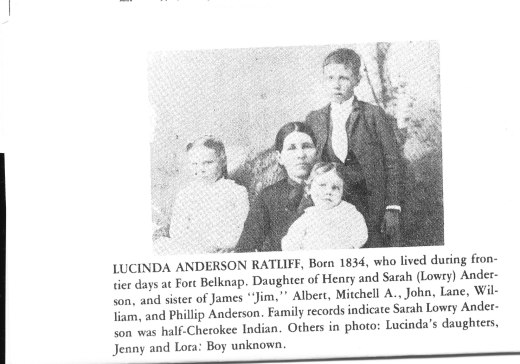
    Lucinda Anderson_0004

In answer to how Sarah Anderson handled the move to Texas, refer back to the book title TOUGHT TIMES NEVER LAST BUT TOUGH PEOPLE DO  and “no matter how tough times get, you have the potential to achieve the best in life”. 

Eternal vigilance, faith and toughness had to be on her side.


 .


Posted in Anderson | 6 Comments

Chapter 2 THE ARKANSAS YEARS 1829-1850

Henry and Sarah moved around 1828-1829 from Amite , Louisiana Territory to Caddo Cove, Arkansas, Territory.   Some suggested they moved to Caddo Gap, however both 1830 and 1840 Federal Census show Henry Anderson and family in Caddo Cove Township, Hot Springs County, Arkansas Territory.  Caddo Gap and Caddo Cove are both near the Caddo River, but they are about 60 miles apart.  Arkansas Territory was first claimed by Spain, then France before becoming part of the Louisiana Purchase.  Arkansas became a separate territory in 1819 and achieved statehood in 1836.  About the time of their move to Caddo Cove, Congress established the boundary’s separating Arkansas from the Indian Territory (now Oklahoma),

 In 1812 Kentuckians Martin and Mary Collier were the first recorded white settlers in this area.  Their daughter, Sarah “Sally” Collier, has been posted as the wife of Henry Anderson.  However, no records of this marriage in Arkansas has been found, only that of Henry Anderson and Sarah Lowry in Amite Co. Mississippi.

This was in the same time period with the “removal” of the Cherokee Indians from their native eastern land to the untamed country west of the Mississippi River.  Many of them, especially those of Indian/White marriages settled in Arkansas.  Francis Griffin, Henry’s mother, was reportedly 1/2 Cherokee.  His grandmother, Sarah Sa Ka Yu Ah Ocoore Griffin was buried in Cherokee Nation, Oklahoma Territory.

We do not know much about the Anderson family during their 21 years in Caddo Cove, only that he and his father, James, came from a long line of ranching families .  It would have been an exciting and challenging time for the family.  Arkansas was a slave state and became the 9th state to secede from the union  and join the Confederate States of America.  In 1832 they saw the removal of the five civilized tribes the Choctaw, Creek, Cherokee, Chickasaw and Seminole’s from Arkansas to the Oklahoma Territory (one  more land promise broken with the Indians by Congress).

We do know that Sarah was kept busy raising 10 children in Arkansas.  Their eleventh child Phillip Jefferson was born later when they moved to Texas.  The Arkansas children were;

James Washington Anderson, born May 29, 1829                                                                 

Twins ….Mary and Prudence Anderson, born January 4, 1831

Elizabeth  Anderson, born November 21 1832.

Lucinda “Sinda” Anderson, born January 11, 1834

Albert Jackson Anderson, born February 15, 1836

Mitchell Harrison Anderson, born February 22, 1837

John Henry Anderson, born February 15, 1839

Delaney, “Laney” Anderson, born April 11, 1841

William Walter Anderson, born June 10, 1844

Not sure about Henry and Sarah’s politics, but we know they liked to name their children after Presidents, James Washington, Albert Jackson, Phillip Jefferson and Mitchell Harrison.


Posted in Anderson | Leave a comment