BILL LEE’S ESCAPE FROM THE LAW

                Wm. “Bill Lee’s” Escape from the Law 

After the La Junta, Colorado saloon shooting, there was no time to pack, just saddle up and get out of La Junta before the sheriff arrives.  Bill headed south following the Goodnight-Loving Trail down through New Mexico.


Cattle Trails of the West

The map might help show his travel route while on the run. There were no highways, just the Goodnight/Loving cattle trail.  Bill Lee  traveled south to Texas and  west to Tombstone.

 William Henry Anderson changed his name to “Bill Lee”.  Possibly the Sheriff poster might have read “Wanted, William, “Black Bill”, Anderson” that led him to change his name?  His new gun belt had the name Bill Lee placed on it.  His daughter said he worked on ranches while making his way through New Mexico down to the Southern California Cattle Trail where he turned west.  Eventually he arrived in Tombstone, Arizona.  Bill Lee became quite good at cards and a poker game called Faro.  His daughters spoke of “dad knowing Wyatt Earp, Doc Holiday, and Buffalo Bill”. We do not have evidence of his playing Faro with these characters. We do know that years later when Bill was reading the newspaper about  Buffalo Bill’s death, he had tears in his eyes and when daughter  Noma asked him what was wrong; he simply said “a good friend had died”.

 Bill found a job and home on the famous John H. Slaughter Ranch near Bisbee Arizona.  As he rode out of Bisbee toward the Slaughter Ranch, he must have wondered how one cow could survive on this rocky land with only mesquite bushes for vegetation.  However, when he rode upon the Slaughter ranch, he found the grama grass was “waist high”, blanketing the long oval San Bernardino valley, which boasted ten natural springs and intermittently flowing stream.  The ranch stretched down into Mexico, rimmed and boarded by mountains all around.

Slaughter Ranch

In 1884, John Horton Slaughter purchased the ranch’s 65,000 acres for $80,000.  The ranch land stretched down into old Mexico.  An interesting story about a Mormon employee of Slaughter’s, who built a home straddling the US-Mexico border so he could keep a wife in the United States and a wife in Mexico.  The home was two rooms, one on each side of the border, with a breezeway connecting them. Wikipedia.

Since the cowboy element made up a small but loud proportion of Cochise County outlaws, it is doubtful that Bill Lee’s past was ever questioned by Slaughter.  What Bill did best was breaking wild horses to ride, probably the only thing John Slaughter needed to know about this young man.  It is told that John Slaughter loved to gamble and play Faro, perhaps that brought Slaughter and Bill Lee together.  We believe Bill worked for Slaughter from 1886 to 1893, while the ranch grew to as many as 500 people living and working there.

 Slaughters fame came as sheriff of Cochise County and cleaning up Tombstone after the Earp brothers and Doc Holiday departed.  After the 1881 Gunfight at the OK Corral, the Tombstone jail became known as the “Hotel De Slaughter”,

 Mexican cattle rustlers were responsible for Bill Lee having one of the narrowest escapes of his life!  Years later he told this story to his daughter, “I spotted some Mexicans stealing Slaughters cattle,  I chased them and crossed over the Mexican border”. However, once he crossed the border, the rustlers captured him and placed him in their jail.  While in jail he became acquainted with the jailer’s daughter.  She brought him his meals each day,  Bill called her “sweetheart”.  She must have grown fond of Bill as she gave him a silk tie (the tie has been handed down to family members over the past 100+ years and is shown below).
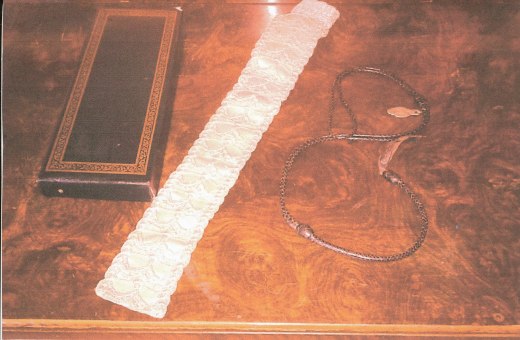
Anderson silk tie

Silk tie and box, a gift from the jailers daughter.  The leather strand has a silver tag with granddad’s alias name “Bill Lee”.

While the Mexican jailer awaited Bill Lee’s fate, his daughter helped Bill escape from the jail, late at night.  ALL of William Henry Anderson’s descendants living today, owe the jailer’s daughter a special THANKS!

Wm. Anderson painting

 The above pictures was painted by a great artist and special friend, Melinda Littlejohn.  Her painting included Deputy Sheriff Anderson with his gun belt that reads “Bill Lee”. The lower part of the picture is Bill’s actual Colt 38 pistol, his shaving mug and silk tie.  The pistol gun handle has a notch, his daughters said there should have been three notches, one for each gun fight. 

TOUGH TIMES NEVER LAST, BUT TOUGH PEOPLE DO.
Posted in Uncategorized | Leave a comment

ON THE MOVE AGAIN

Chapter 14

                                         ON THE MOVE AGAIN

 The 1880 Census of Bent County, Colorado, list Albert Jackson Anderson, age 43, occupation Stock Grower.  Their children, William H. age 12, Malinda age 10, Martha age 8, all attending school in the log cabin building Albert built.  Also, home in La Junta and to young to attend school were Minnie, Albert Calvin, May, and Nancy Belle.  Mother Nancy, age 33, occupation listed as “keeping house”.  It would have been a full-house 9 children  with Nancy’s nephew Henry Wilson age 14 and niece Mary Belle Wilson, age 16, also living there

While living in La Junta the family saw their tiny community grow to 285 inhabitants.  The town consisted of one school,  one hotel, three saloons, two section houses, eleven residences, one general store, two restaurants, one engine pump house, one Adams Express House, one ice house, one Wells Fargo station, one blacksmith shop, one boarding tent and one barber shop.

 The Goodnight-Loving cattle trail  ran between La Junta, Colorado and Texas.  When the trail ended it put a halt to Albert’s occupation of breaking and  driving horses down the trail.  Sometime before 1890 the family moved to Mobeetie, Texas.  Temple Houston, son of the famous Sam Houston, wrote his wife, “Mobeetie is a bald-headed whiskey town with few virtuous women”.   They lived near where Albert’s parents, Henry and Sarah ranched.   His brother John Henry lived three miles below his father’s ranch, brother William Walter lived along Spring Creek, near Mobeetie. And his sister Elizabeth and her husband lived close, along the Washita River.

Albert James Anderson_0002

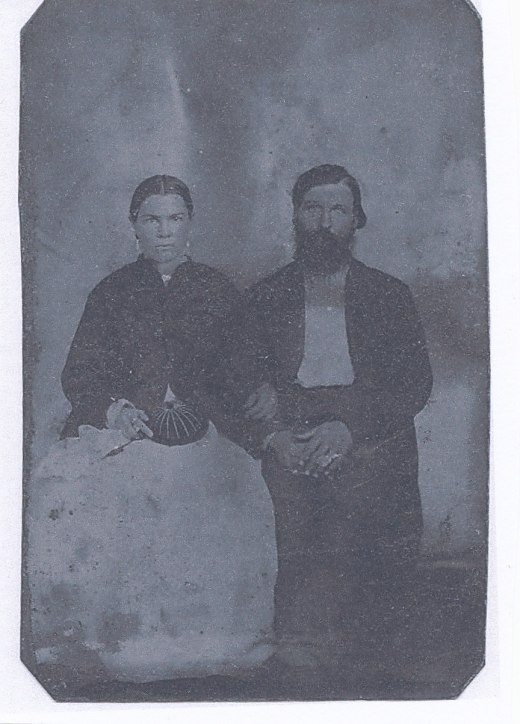
                                             ALBERT and NANCY ANDERSON

 Albert and Nancy stayed only a short time in Mobeetie before they moved about 40 miles east along Rush Spring, Red Moon, Oklahoma, Territory.  This would have been about the same time period that his son, William H. Anderson and wife Tommie Lee, had homestead there.  Albert and his son were once again back in the horse and cattle business together.

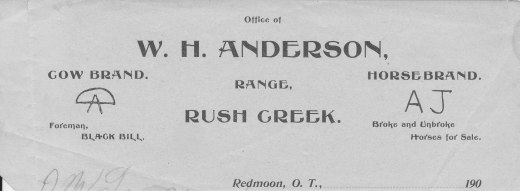
anderson-stationary


   The stationary from William and Albert’s ranch.  William “Black Bill” Anderson’s  brand on the left corner and Albert J. Anderson’s brand on the right corner.

 Nancy and Albert only stayed in Red Moon,  18 miles northwest of Cheyenne, OT, a short time and moved again to Sayre, Oklahoma TerritoryIn a letter to Albert’s sister Lucinda, dated March 25, 1903, Nancy wrote “we came to Sayre (Oklahoma Territory) last October and rented a hotel and are working it and just making a living.  We have to work very hard but that is all right as long we can make a living. Albert has been in bad health all winter, not able to do but very little, he stays here a while and then goes to the place (ranch) and stays with Will (son William H.) for a while.  He feels sure he will get his Indian money this next summer and if he does we will surely come to see our dear old sister and her children.  I do hope and pray that the Lord will spare us until we meet once more on earth once more”.

 Another letter dated November 15, 1903, Nancy wrote to her sister-in-law, Lucinda.“Now sister about your Indian claim.  We know Arch lost horse and cattle, now if you can remember any dates he lost stock make out your claim.  We have never got any thing out of our claim yet but we still think we will.  We talked for a year that if we got our Indian money our first trip would be to see sister Sinda (Lucinda)”….  For years our family thought Albert’s claim for “Indian money” referred to his Cherokee heritage.  However, these letters indicate that a claim was made to the government for cattle and horses stolen by Indians from his ranch.

 According to stories from Albert and Nancy’s granddaughter, Noma Anderson Powers, they did receive Indian money and moved to Laurel, Montana.  Their daughter, Nancy Belle who married Burt Woodward, lived in Laurel.  Nancy and her daughter operated the Lennox Hotel in Laurel.  Information taken from LAUREL’S STORY, A MONTANA HERITAGE by Elsie P. Johnston.

Anderson, Laurel Hotel_0001

William H. Anderson wrote on the picture “Mothers hotel at Laurel, Montana”. 

Lenox Hotel

 Albert evidently did not take to working in his wife’s hotel.  According to his granddaughter, Leona Anderson “Albert took to mining in Montana and Wyoming”.  Maybe it was the gold rush that resulted from the discovery at the Clark’s Ford headwaters that attracted Albert.

 In 1906 Albert knew he did not have much time to live.  He was a Baptist and Nancy was a Methodist and he “wanted a Baptist burial”.  So he journeyed back to Red Moon, OT.  How he got their, we do not know.  On December 3, 1906, he died in his son William Henry Anderson’s ranch.  He got his Baptist burial in Cheyenne, Oklahoma.  Like his father Henry M. Anderson, Albert lived a very colorful life in the wild west……a cowboy, a Civil War soldier, a Texas Ranger, a horse trader and a gold miner.

 Thanks to Elsie Johnston’s book on Laurel Montana and a June 18, 1918 newspaper clipping, we learned about Nancy’s life after Albert’s death.  Her eighth child, Nancy Belle Anderson, had married Burt Woodward and lived in Forsyth, Montana.  After Burt died, she and her two year-old son moved to Laurel to join her mother Nancy.   Anderson, Nancy.

Nancy A. Anderson (right) and Ada Cobler.  Grandmother Nancy’s sister died and she took her child Ada and raised her from an early age.

Nancy Wilson Anderson_0001

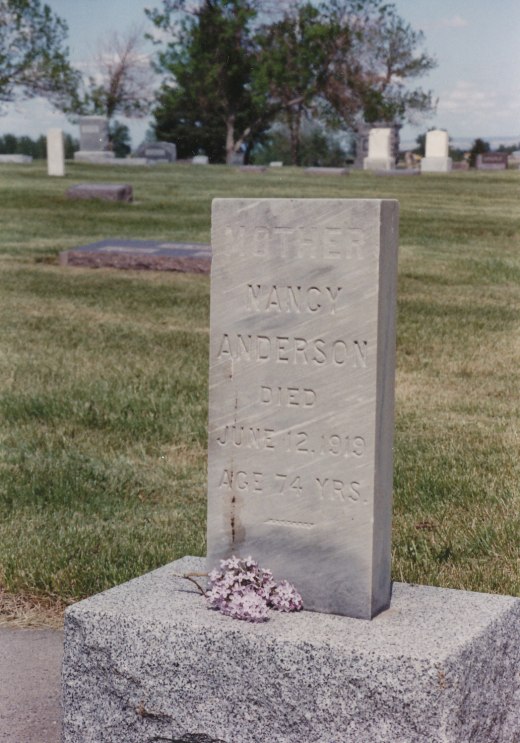
My wife Jane found great-grandmother Nancy’s grave stone while visiting in Laurel, Montana.

 Nancy Alvera Anderson lived with her daughter for her last ten years and died in her daughters home,  Nancy Belle McFadden, on June 12, 1919, at the age of 74.  She was an untiring and consistent member of the Methodist Episcopal Church.


­

­

­

­

­

­

­

wers, they did receive Indian money and moved to Laurel, Montana.  Their daughter, Nancy Belle who married Burt Woodward, lived in Laurel.  Nancy and her daughter operated the Lennox Hotel in Laurel.  Information taken from LAUREL’S STORY, A MONTANA HERITAGE by Elsie P. Johnston.


                        NANCY’S HOTEL IN LAUREL, MONTANA


Albert evidently did not take to working in his wife’s hotel.  According to his granddaughter, Leona Anderson “Albert took to mining in Montana and Wyoming”.  Maybe it was the gold rush that resulted from the discovery at the Clark’s Ford headwaters that attracted Albert.


In 1906 Albert knew he did not have much time to live.  He was a Baptist and Nancy was a Methodist and he “wanted a Baptist burial”.  So he journeyed back to Red Moon, OT.  How we do not know.  On December 3, 1906, he died in his son William Henry Anderson’s home.  He got his Baptist burial in Cheyenne, Oklahoma.  Like his father Henry M. Anderson he had lived a very colorful life in the wild west……

a cowboy, a Civil War soldier, a Texas Ranger, a horse trader and a gold miner.


Thanks to Elsie Johnston’s book on Laurel Montana and a June 18, 1918 newspaper clipping, we learned about Nancy’s life after Albert’s death.  Her eighth child, Nancy Belle Anderson, had married Burt Woodward and lived in Forsyth, Montana.  After Burt died, she and her two year-old son moved to Laurel to join her mother Nancy.   After moving to Laurel Nancy Belle married J.J. McFadden.  The mother and daughter operated the Yellowstone Hotel, which was a frame building.  According to the book, they also operated the Lennox Hotel, a building still in existence.  The brick hotel was “supplied with hot water and baths and the rooms were well lighted and ventilated”.


Nancy Alvera Anderson lived with her daughter for her last ten years and died in the home of Nancy Belle McFadden, on June 12, 1919, at the age of 74.  She was an untiring and consistent member of the Methodist Episcopal Church.


Posted in Uncategorized | 1 Comment