In Williamson County, Texas, 1850-1855 was wedding time for several of Henry and Sarah Anderson’s children
Mary Anderson married Phillip S. George, 20 October 1850.
Lucinda Anderson married Archelaus Ratliff, 30 June 1853
Elizabeth Anderson married James S. George, 1854
James “Jim” Anderson married Margaret Eaves, 21 Oct.1855.
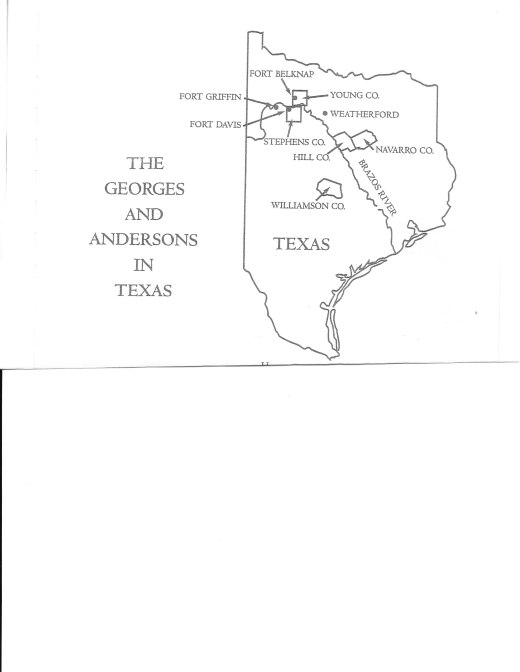
After five years in the Milam/Williamson District, Henry had itchy feet to move again. In 1855, the lure of millions of longhorn cattle in west Texas, found the Anderson, Ratliff and George families , inching north and west about 250 miles to Young County, (west of Ft. Worth and Weatherford, Texas). Again the journey had to be miserably slow and brutally painful in covered wagons across hostile Indian territory.
Around 1856, county records show Henry Anderson, along with Philip and Henry George had migrated to Young County, Texas. The Young County Commissioner Court Minutes, book 1 read “the Anderson brothers arrived in Young County in April 1856, one of them (Mitchell) married one of the Sutherlin girls”. Not sure of the exact date when James S. George and his wife Elizabeth Anderson came to the area, but they are listed in the 1860 census of Young County. There is a creek in Young County named for Phillip George and another named for his brother-in-law, Jim Anderson. Both empty into the Brazos River near Miller Bend. Henry and Sarah were believed to have settled between Graham and Fort Belknap, along the Brazos River.
This would be a time where the Apache/Comanche Indians and the white families (such as the Anderson, Ratliff and George’s), were battling for the control of Young County. Henry George was one of four men who called for an election to organize Young County in 1856. Phillip George, Mary Anderson’s husband, was a prominent citizen and loaned money to area settlers.
For safety from Indian raids, Henry and family lived in or near the military Forts, Belknap, Davis and Griffin. From the book LONESTAR by T.R. Fehrenbach, we find the government placed a string of forts along the Comanche frontier. These forts never adequately served their purpose, which was protection of the white frontier to their east. They did not and could not separate Indians raiders from the white settlements. When the federal government assumed the job of protecting the Texas frontier, its army had no formal cavalry branch. Some of the first troops sent out on the edge of the vast Plains were infantry, mounted on mules. As Texans remarked bitterly, the only way they could damage the hard-riding Comanche was possibly by causing the Indians to laugh themselves to death. Conditions did improve briefly by gathering border Indian tribes into the reserves which helped end petty depredations. More important was the appearance of the best-mounted regiment that ever rode the American West, the 2nd U.S. Cavalry.
The year 1860 in west Texas is best described by S.C. Gwynne’s book, EMPIRE OF THE SUMMER MOON, “one of the bloodiest years in the frontier”. Following many Comanche raids. All hell broke loose. People panicked and fled the frontier as fast as they could. Within days there were hundreds of deserted farms in the area west of Weatherford, Texas. The raids were remarkable because the panicked whites in that arc of settlement, west of Fort Worth, did not seem to be able to do anything to stop them. Governor Sam Houston had authorized Colonel M.T. Johnson to raise a regiment of Rangers to punish the Indians. It was a failure.
Yet not everyone was leaving. Henry M. Anderson and his boys, James, Albert, Mitchell, John, William and Phillip, were in the cattle and horse business with no intentions of leaving (tough times never last but tough people do).
 Who is my granddaddy?
Very interesting Jim…..I’m a ggrandson of Lucinda Anderson and Arch Ratliff …..have been researching our family @ 40 years …can’t wait to share treasures… 🙂 Can see that some of my info has circulated to you….Do you have copies of 5 Civil War letters that Arch sent home to Fort Belknap to his wife Lucinda ?
Eric, my next blog will be about Henry and the Civil War period. If you have one of the Civil War letters that Arch wrote that you would like to share on my blog it would be appreciated. Thanks, Jim Had you ever read about hanging brother James?
Just found out which unit Arch Ratliff was in (There are more and more records on the internet all the time) It seems that he went back to Florence to join a Williamson County company (To be with his brothers I assume) In his first letter he mentioned his company commander was Captain Vontress (Edward H. Vontress was in charge of Co.A of Morgan’s Texas Cavalry Battalion which was part of Parson’s Brigade) He also mentions Polk , who my grandmother Frankie Ratliff Devaney says was his brother Job Marshall Ratliff , who she knew , having died when she was 12. Both Arch and Polk are buried in Ebony Cemetery with their wives Lucinda and Susan (Meeks). Also buried there is Lora Ratliff , Arch &Lucida’s daughter , who according to my grandmother died on a trip to LaJunta Colorado to visit relatives when she was 19 . Not sure how to navigate this format….my technical advisor & wife is in California….So if this is OK ,I’ll just type in the 1st letter ,datedJune 21 , 1862…It was the only one he wrote with his own hand….and you’ll see that besides there being no punctuation or capitols it is all written phonetically….which is very cool , because you can actually “hear” his accent in the letter…..
June the 21 AD 1862 Dear wife I a gane take my pen I hand to let you know that I am well at present and hope when these few lines comes to hand they may find you injoing the same blessing we are encampt at this time at dewvalls bluf in Arkansas white river we left little rock in a hury to get hear expecting to have little fite with the yankise but when we got hear we did not get it but we would like to had a little frolick with them but we did not get it dewvalls bluffs is 60 miles below little rock on white river we was expecting their gun boats up but they got in fifteen miles of the bluffs and backed out and went off backed down the river we are just a wating on them when they say the word they the wol flies we would like to have a frolick with them awful well we think we could croud them from the ground they stand on I want you to tell Mrs Baker that henry is well and doing first trate in fact we rite to gether if we cold get in a fite or too and live over it we cold come home first satisfide tell Mrs Baker that henry says that if he lives he expect to go home in too or three months they had a little fite down below us on white river at Saint Charles and we whipt them very easy they had five gun boats we sunk one of them and crippled a nother we shot threw one of their boilers kild and scolded a bout a hundred and sixty and our los was 8 we don’t know how long we will stay hear we are acting picket gard for kernel nelssions regiment I expect to bee at home a bout the first of September if nothing hapins I will let you know that I saw ed bond sick at little rock and ben bond died in the hose pitle a bout a week before I saw ed I would like to see you and the children mity well once more I want you to rite as soon as you get this leter and lete me know how you all are getting on and how Tom has got Direct your leters to little rock under the cear of Capt.vontres company that is Capt.vontress so I will close my leter Arch Ratliff to Lucinda Ratliff
Eric, thank you so much, a wonderful letter for that time period. Jim